




Key takeaways
- Local laws override home-country playbooks: Standard domestic HR practices — like U.S. at-will employment — fail internationally, where notice periods, local tax rules, and benefits apply.
- AI HR tools face strict compliance rules: Global regulations like the EU AI Act mandate human oversight, bias auditing, decision logging, and candidate transparency for AI used in recruitment and talent management.
- Adopting the strictest standard simplifies compliance: Aligning your AI governance with high-watermark regulations (like the EU AI Act and California privacy laws) protects your business across every market you enter.
- Modern tech eliminates expansion friction: Using an employer of record (EOR) with specialized AI tools like G-P Gia™ allows you to onboard talent in over 180 countries without the time, complexity, and initial expense of establishing local legal entities.
What is HR compliance in a global workforce?
HR compliance means aligning your international workforce management with local labor laws, payroll tax structures, statutory benefits, and privacy rules wherever you hire.
Ditch the domestic playbook
Copying your home country's employee handbook into new markets backfires. For example, if you’re used to U.S. at-will employment, you can assume you can part ways with an employee at any time. But outside of the U.S., that approach breaks the law.
Most international markets have notice periods, set severance calculations, and termination protections. In Germany, employers need a legally justified reason to end employment. This includes a written notice with a wet signature, works council consultation, and tenure-based notice periods. Skip those steps and employees can challenge it and seek reinstatement.
G-P helps you maintain HR compliance and avoid termination missteps by localizing the process. You can use our Global Employment Platform to work through local notice periods, severance rules, documentation, final pay, and required procedures before ending employment. That helps you avoid common mistakes like terminating by email, skipping consultation, or miscalculating notice.
Watch out for hard vs. soft breaks
Managing an international team introduces two types of operational risks:
- Hard breaks are legal and financial failures. A company can call someone an independent contractor in a new market while managing them like a full-time employee. That can lead to misclassification claims, back taxes, unpaid benefits, penalties, and lawsuits. In France, concealed work violations can carry fines up to EUR 225,000.
- Soft breaks are cultural and retention failures. A company can roll out the same benefits package everywhere and miss local expectations around vacation, public holidays, meal allowances, or work-life norms. That can signal that you don’t understand the market, hurting your brand and retention.
Focus on cross-border data privacy
Cross-border data management is an important business priority. When you transfer employee details across borders, you handle sensitive data subject to strict regulations like Europe's GDPR. Securing this pipeline protects your company's reputation and shields you from non-compliance penalties.
If employee data is transferred across borders without the right safeguards, regulators can:
- order the company to stop the data flow
- investigate its HR systems
- impose fines.
Ireland’s Data Protection Commission issued a EUR 1.2 billion fine against Meta over cross-border transfer violations.
The evolving regulatory landscape: AI HR compliance and global standards
AI brings regulatory scrutiny. You need to understand how AI HR compliance can impact your tech stack so you can protect your business from legal risks.
High-risk AI in employment
Tools that rank candidates, analyze video interviews, or track employee productivity directly impact people's livelihoods. Because algorithms can accidentally encode bias, authorities flag automated HR software as high-risk technology.
If you roll out an AI hiring tool to rank applicants across Europe, you have to be prepared to show that the tool is:
- documented
- monitored
- transparent
- subject to meaningful human oversight.
The EU AI Act mandate
If you use AI for recruitment, selection, or workforce management involving people in the EU, the EU AI Act can impact your operations. Under Article 6 and Annex III, many AI systems used in employment, workers’ management, and access to self-employment are classified as high-risk. This includes tools used for hiring, promotion, termination, task allocation, monitoring, or performance evaluation.
- Extraterritorial reach: The Act can apply to non-EU companies where the output of an AI system is used in the EU, including in decisions involving EU-based candidates or workers.
- Human oversight: High-risk HR AI systems have to be subject to effective human oversight so responsible people can understand, monitor, and, where appropriate, override or stop the system. Separate data protection rules can restrict solely automated employment decisions.
- Risk management and data governance: High-risk systems need documented risk-management processes and appropriate data governance, including attention to data quality, relevance, representativeness, and bias risks.
- Logging and record keeping: High-risk systems have to allow appropriate automatic logging so their operation can be monitored, audited, and investigated where needed. Retention periods have to be set based on AI Act, GDPR, employment-law, and internal governance requirements.
- Transparency and explanation: High-risk HR AI systems have to be transparent for deployers to use them properly. Say a company uses an AI tool to score and rank job applicants. Under the EU AI Act, that type of recruitment system can be high-risk. Candidates and hiring teams need clear information about how the system is used, what factors it considers, and its limits. Where automated processing or high-risk AI substantially informs employment decisions, workers and candidates can have explicit rights to human review and explanation under applicable laws.
The U.S. state and municipal patchwork
In the U.S., rules vary by city and state:
- NYC Local Law 144 requires employers using automated employment decision tools for hiring or promotion to complete an independent bias audit within one year before use. Employers have to publish a summary of the audit results and give advance notice to covered candidates or employees.
- Illinois HB 3773 includes the Artificial Intelligence Video Interview Act. This requires notice, explanation, and consent before AI analyzes applicant video interviews, and amendments to the Illinois Human Rights Act. These amendments prohibit discriminatory use of AI in employment decisions.
- California CCPA/CPRA ADMT Rules extend privacy protections to workers and applicants. It adds notice, opt-out, and risk-assessment obligations for certain automated decision making tools used in HR decisions.
"Employment compliance is the perfect use case for AI. And not just for global compliance. Right now, in the United States, every state is implementing new regulations that differ from other states that you have to stay on top of. So even if you're just in the U.S., even in one state, those regulations are constantly changing. Never mind when you wind up being in multiple countries." — Laura Maffucci, VP, Head of HR at G-P.
Adopt a strictest-baseline strategy
Managing dozens of local AI laws gets overwhelming. When you set your internal AI governance to match the toughest standards, you streamline compliance.
G-P helps you turn AI compliance into a repeatable global playbook. If you want to use an AI recruiting tool across multiple countries, G-P can help:
- identify where the tool triggers high-risk employment rules
- map applicant data flows
- check vendor safeguards
- build human oversight into the hiring process
- support privacy notices and worker communications.
Instead of rebuilding the process market by market, you can start from a high-standard baseline informed by frameworks like the EU AI Act and California privacy rules, then localize where needed.
Important global HR compliance tools and platform solutions
Scaling across borders no longer needs months of legal paperwork. Modern global HR compliance tools give you the infrastructure to hire, pay, and manage talent anywhere with confidence.
Entity setup vs. employer of record (EOR)
Opening local legal entities in new countries is traditionally slow, complex, and expensive. You have to navigate local tax registrations, set up bank accounts, and hire local legal teams.
By using an EOR, you can hire talent in over 180 countries without setting up local entities. You get speed to market while shifting core local employer liabilities and administrative duties to the EOR.
“Speed-to-hire was amazing. Literally in 10 days, G-P solved a problem the organization had been struggling with for 10 months.” — Ishan Pandya, New Business and Strategy Manager at Trent.
Build an integrated tech architecture
Your global employment platform needs to work seamlessly with your main workforce management stack using HR compliance tools:
- Enterprise systems sync: Connect your global employment data directly to your core HCM platforms — such as Workday, ADP, and SAP SuccessFactors — using real-time APIs. This integration maintains a single source of truth for your entire workforce.
- Automated document generation: Create localized, legally compliant employment contracts in minutes. G-P Contractor helps companies engage, document, onboard, pay, and manage global independent contractors more efficiently, while reducing the risk of using generic agreements that don’t fit the local market.
Agentic AI intelligence: meet G-P Gia™
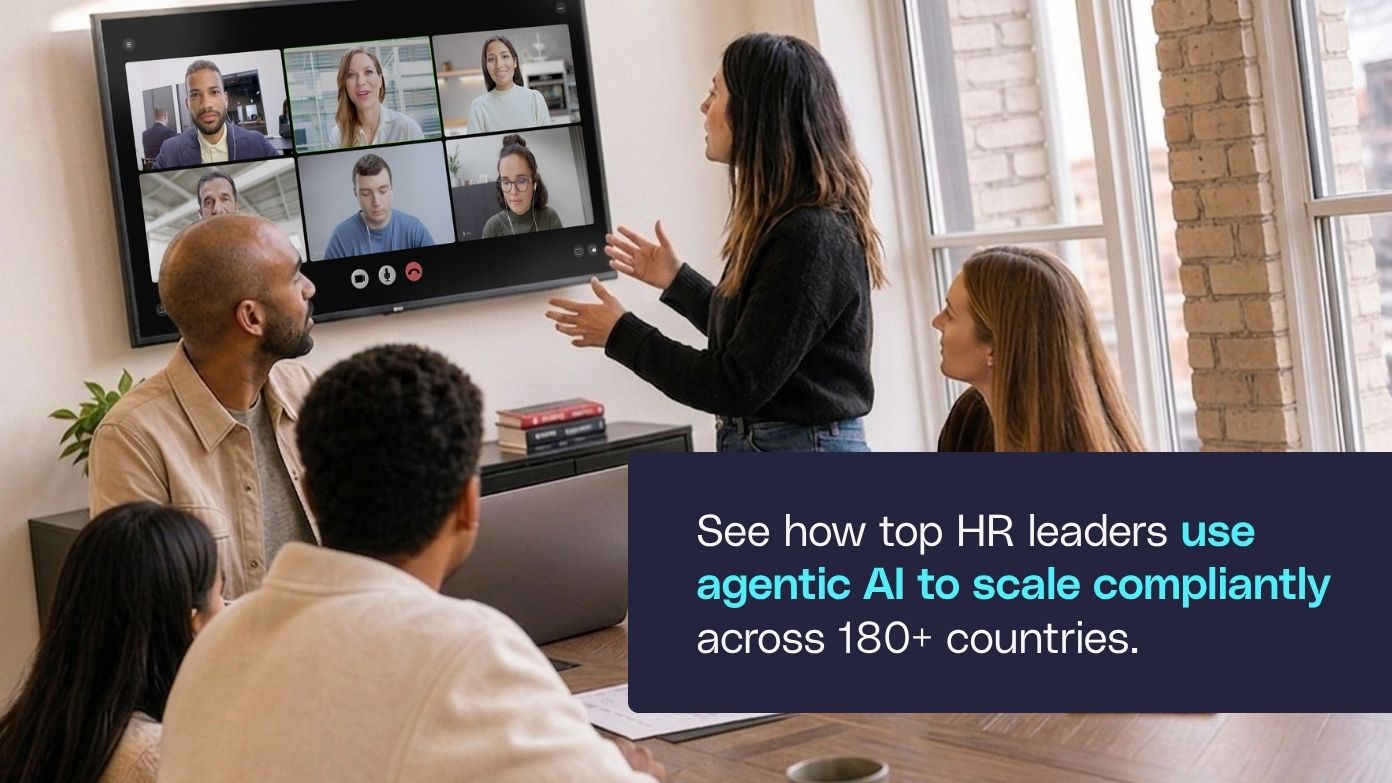
Gia draws on over a decade of legal expertise, 1,500 government sources, and 100,000 vetted articles. It delivers instant, expert HR guidance and generates fully compliant documents across 50 countries and all 50 U.S. states. You get trusted answers in minutes instead of waiting days for outside counsel.
“An AI tool like Gia, isn’t just a black box; it's a tool that’s actively and transparently overseen by both HR and IT experts. I think people are far more likely to trust the outputs that they're getting from it. HR provides the assurance that the tool is being used ethically and fairly and that it's applicable while IT provides the confidence that it's secure and compliant. It's a shared responsibility and it demonstrates commitment both to data integrity, but also to humans.” — Connie Diaz, Senior Director, HR at G-P.
Automated contractor classification
Automated contractor classification helps companies catch misclassification risk before a contract is signed. If a company wants to hire a contractor who will work full time, follow a manager’s schedule, use company tools, and perform core business work, the tool can flag that the person can legally look more like an employee. The company can then adjust the engagement, get legal review, or hire through the right model before facing back taxes, penalties, or disputes.
G-P’s contractor misclassification engine is proprietary AI technology that reviews existing contractor agreements to identify misclassification risks and offers precise, actionable recommendations for compliance. This helps keep your business operating within global regulations.
Building a cross-functional compliance framework
Maintaining HR compliance protects your business. Doing so while scaling needs every executive to play an active role.
Aligning your leadership team
Each executive plays an important role in managing risk while driving international growth:
- Chief People Officer: Focuses on hiring top global talent quickly without waiting for local entity setups.
- VP of Legal: Evaluates risk reduction, ensures localized contract enforceability, and maintains AI HR compliance standards.
- CFO and payroll leaders: Works on accurate tax withholdings, maintains predictable operational costs, and delivers timely payments across currencies.
"You have to get in front of AI. I think it's a unique opportunity for HR to actually be leading something. The way to ensure your organization is successful with adopting and using AI is to make sure your employees are coming along. And HR is uniquely positioned to do that." — Laura Maffucci, VP, Head of HR at G-P.
Key actionable steps for leadership
To build a resilient framework for global HR compliance, focus on these priorities:
- Adopt an EOR solution: Use an EOR, like G-P EOR, to launch into new markets quickly and safely without setting up local entities.
- Set up human-in-the-loop workflows: Require human oversight for every AI-assisted hiring, screening, or scoring tool you deploy.
- Treat worker classification as an ongoing audit: Review contractor status continuously rather than relying on a one-time setup check.
- Connect your data dashboards: Integrate real-time compliance data across HR, Legal, IT, and Finance systems to keep total visibility.
G-P’s AI tools help leadership turn global compliance into an active operating system. Gia gives teams fast, country-specific employment guidance. G-P Assist helps users take the right next steps inside the platform. G-P’s Global Compliance Engine helps power localized checks and workflows across hiring, onboarding, payroll, contracts, and workforce management. Together, they support:
- faster market entry through EOR
- stronger human oversight of AI-assisted decisions
- more disciplined contractor review
- better visibility across HR, Legal, IT, and Finance.
Grow your global team with compliance you can trust
G-P (Globalization Partners) is the leader in global employment. As the world's first agentic Global Employment Platform, G-P codes global labor laws and compliance directly into existing corporate workflows, helping companies of all sizes manage the employee lifecycle.
We support teams in 180+ countries backed by more than a decade of global operational data and the largest team of in-country HR, legal, and compliance experts. This unmatched proprietary knowledge powers our EOR, Contractor, and global HR agent, G-P Gia™, products.
Hire anywhere and scale everywhere with G-P. Request a proposal today.
Frequently asked questions
What is global HR compliance?
Global HR compliance aligns international workforce management with country-specific labor laws, statutory benefits, tax withholdings, worker classification, and data privacy regulations in every country where you employ talent.
Why are AI hiring tools classified as high-risk under the EU AI Act?
The EU AI Act classifies AI tools used in recruitment, applicant screening, task allocation, performance evaluation, and termination as high-risk because automated decisions directly impact career opportunities, worker rights, and livelihood.
How do HR compliance tools help companies expand internationally?
HR compliance tools automate local contract creation, streamline payroll tax withholdings, audit worker classifications, and sync workforce data with enterprise HCM systems like Workday and SAP SuccessFactors to reduce manual compliance errors.
What is the difference between setting up a local entity and using an EOR?
Setting up a direct legal entity needs big capital, local legal counsel, and months of administrative setup. An EOR lets you onboard and manage global team members legally in minutes using an established in-country infrastructure.