








Key takeaways
- Hiring in Canada: Hiring employees in Canada allows your business to tap into a highly skilled, diverse workforce and access the North American market via the USMCA.
- Target talent hubs: Focus your efforts on major hubs like Toronto, Vancouver, and Montreal to find specialized talent for tech, finance, and engineering roles
- Compliance is key: Understand your obligations regarding vacation leave, CPP, employment insurance, and income tax before you hire in Canada.
- Classify workers correctly: Avoid the risks of misclassification by learning the legal distinctions between hiring contractors vs. employees in Canada.
- Use G-P EOR: You can hire employees in Canada without an entity by using an Employer of Record (EOR) to handle payroll, taxes, and benefits administration compliantly.
Canada is a highly developed and open market economy. It offers access to North American and global markets through various trade agreements, such as the United States-Mexico-Canada Agreement (USMCA).
Canada is larger than the European Union combined and is home to approximately 40 million people. You’ll have no problem finding qualified workers in Canada, particularly in sectors like ICT, engineering, oil, and gas. Our guide will tell you everything you need to know about hiring employees in Canada.
What to know before hiring employees or contractors in Canada
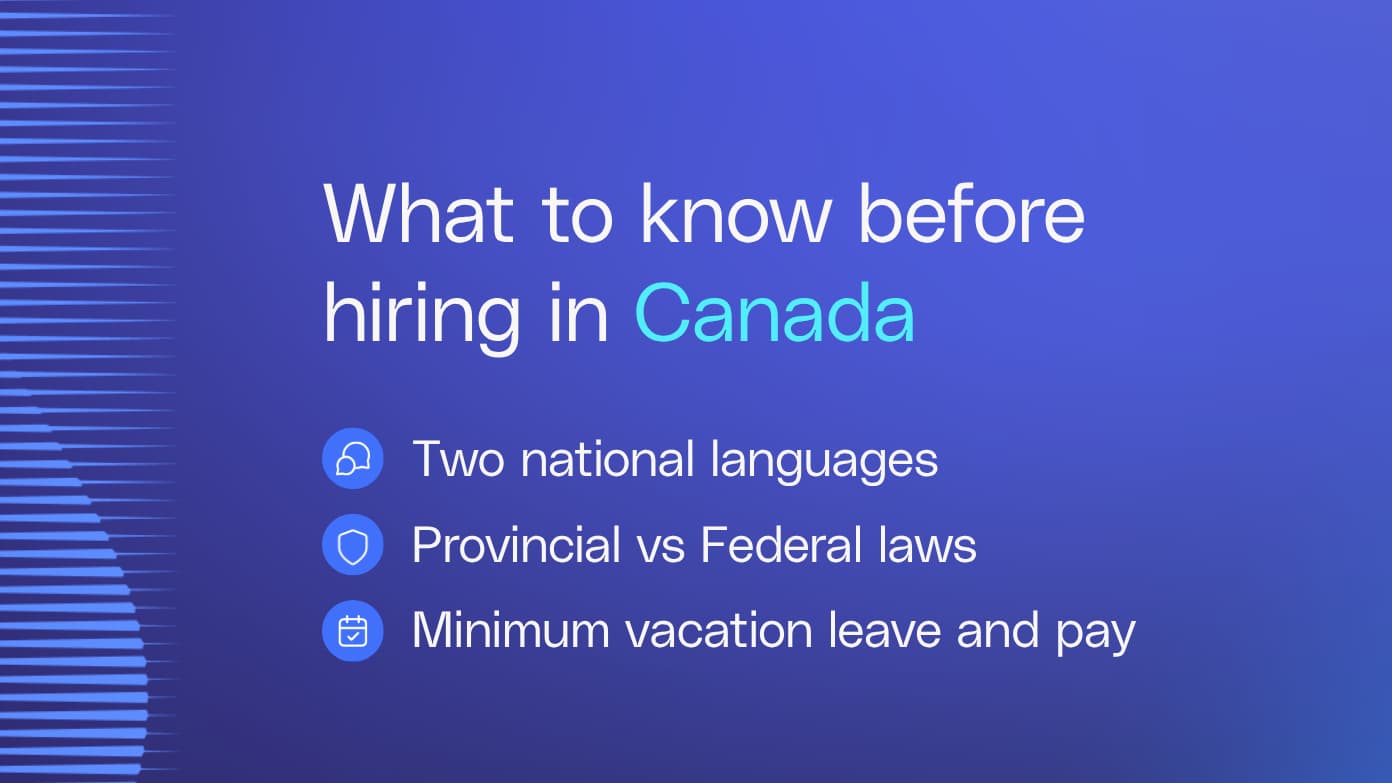
If you’re hiring employees in Canada for the first time, there are important legal requirements to be aware of. These norms and laws influence hiring in Canada and many aspects of the employer-employee relationship.
If you’re unsure where to begin, G-P Gia™, our AI-powered global HR agent, can answer your toughest compliance questions across 50 countries — including Canada — and all 50 U.S. states. Reduce your reliance on outside counsel and cut the time and cost of compliance by up to 95% with Gia.
Let’s take a look at six things to know about hiring in Canada.
1. Language diversity
Canada has two national languages: English and French. You’ll mainly encounter French-speaking workers in the province of Quebec, especially in the Greater Montreal region. Many Quebecois also speak English — 46% are English-French bilingual.
2. Provincial vs. federal laws
Employers have to first determine if they’re federally regulated and identify the employee’s province or territory of work to apply the correct Canadian employment rules. This analysis identifies the applicable labor standards, health and safety rules, and human rights laws.
Gia can answer your global compliance questions and give you guidance on Canada’s provincial and federal laws. Gia leverages G-P’s 13+ years of global employment experience, along with insights from almost a million real-world scenarios, to provide accurate, up-to-date employment law information.
3. Vacation leave and pay
Federal law dictates vacation leave in Canada. According to the Canada Labor Code, employees are entitled to:
- At least two weeks of vacation leave: after one year of employment
- At least three weeks of vacation leave: between 5-10 years of employment
- At least four weeks of vacation leave: after 10+ years of employment
Vacation entitlements can vary by province, and some provinces have different rules regarding vacation time for long-term employees.
In Canada, employers calculate vacation pay based on the employee’s earnings over their most recent year of employment, and multiply that number by a percentage. The percentage is 4% for employees entitled to two weeks of leave. It’s 6% for three weeks of leave.
You can easily manage vacation leave and administer benefits plans when you hire employees in Canada with G-P EOR. Our in-house experts continuously monitor employment laws to meet country-specific regulations and norms. Build and manage benefits plans through our platform to provide a smooth employee experience.
4. Canada pension plan
Employees in pensionable employment outside Quebec contribute to the Canada pension plan (CPP) once they’re over 18 and earn more than CAD 3,500. Contributions continue until age 70. Employees aged 65 who’re getting a CPP or QPP retirement pension can stop contributing. Employees whose province of employment is Quebec contribute to the Quebec pension plan (QPP) instead.
For 2026, CPP contributions are shared equally by employees and employers.
- The first-tier CPP rate is 5.95% on earnings between CAD 3,500–74,600.
- The second-tier CPP2 rate is 4% for both employees and employers, applying to pensionable earnings above the year’s maximum pensionable earnings (YMPE) and up to the year’s additional maximum pensionable earnings (YAMPE). This is CAD 85,000 for 2026.
Employers are responsible for:
- calculating and deducting employee CPP contributions
- matching them dollar-for-dollar
- remitting both shares through payroll
- updating payroll systems annually for the current rates and thresholds.
5. Employment insurance
Employment insurance (EI) provides financial help to people who are temporarily out of work. As with pension contributions, employers also have to calculate the right amount and deduct EI premiums from employees’ paychecks. This applies to employees in “insurable employment,” which covers most workforce roles when hiring employees in Canada.
Each month, employers deduct a certain amount from employees’ paychecks and also pay an employer share of premiums. Employers stop deducting the premiums once the employee’s earnings reach the maximum insurable earnings or they’ve contributed the maximum amount.
6. Income tax
Canada uses a progressive income tax system. Higher income is taxed at higher rates. In 2025, federal tax rates range from 15% to 33%, depending on income level. Employers must withhold federal and provincial income tax, Canada Pension Plan (CPP) contributions, and EI premiums from employees’ paychecks.
Don’t let payroll slow your plans for global success. Streamline the entire employee lifecycle when you hire in Canada — including global payroll with accurate deductions — in just a few clicks with G-P EOR.
Hiring models for global companies in Canada
The best model when you decide to hire employees in Canada depends on your overall business goals.
|
Model |
Known for |
Best for |
Main risks |
|---|---|---|---|
|
Direct employer registration |
Hiring Canadian employees directly without setting up a Canadian subsidiary, while registering for required payroll and local employer responsibilities. |
Companies testing the Canadian market or employing a small number of Canadian remote workers. |
Payroll withholding, CRA payments, T4 reporting, workers’ compensation, Quebec-specific rules, benefits, and multi-province compliance complexity. |
|
Employer of Record, like G-P EOR |
Faster hiring through a third-party legal employer that manages key employment administration. |
Fast expansion, short-term hiring, or hiring in Canada without creating an entity. |
Less direct administrative control, vendor dependency, and residual client risk for day-to-day management. |
|
Subsidiary or branch |
Greater control, brand presence, and a permanent Canadian operating structure. |
Large-scale hiring, long-term commitment, regulated operations, or building a physical presence. |
Setup costs, corporate governance, tax exposure, payroll and employment compliance, and administrative overhead. |
|
Independent contractor |
Lower upfront cost, speed, and project-based flexibility. |
Specialized independent short-term project work or ad-hoc consulting. |
High misclassification risk, including CRA assessments, unpaid CPP/EI, back pay, workers’ compensation premiums, and possible common-law notice liability. |
Top hiring hubs in Canada
Some Canadian cities are known for particular industries. Knowing what each city offers can help focus your efforts when planning to hire employees in Canada to fill roles faster.
The top talent hubs in Canada are:
- Toronto is often called Silicon Valley of the North. It’s the largest tech hub in Canada and the third largest in North America. The city has a skilled workforce in AI, machine learning, fintech, software development, cloud computing, and cybersecurity. Major companies like Google, Amazon, and Microsoft have a presence here.
- Vancouver is a growing tech hub on the West Coast. It’s mainly known for software development, gaming, animation, visual effects, and VR/AR. The city is also making strides in clean technology and sustainability.
- Montreal is a leader in AI research and development. It’s home to the Quebec AI Institute and one of the world's largest video game development centers, which brings the city specialized talent in AI, machine learning, data science, game design, and software engineering.
- Calgary is known as Canada's energy capital. While the city has skilled talent in oil and gas, it’s now diversifying to renewable energy and clean technologies. This includes expertise in petroleum, chemical, mechanical, and civil engineering.
- Ottawa has a large federal government presence, creating a strong talent pool in public administration, policy, and government-related IT. The city is also an important cybersecurity, telecommunications, and defense technology hub driven by government contracts and research and development.
Key industries in Canada
Understanding Canada’s main industries helps you benchmark salaries and benefits when navigating the process of hiring in Canada. You can use this insight to make smart choices about where to invest:
- ICT: Canada's technology sector is growing rapidly, with major centers in Toronto, Vancouver, and Montreal. The Canadian government supports this sector through programs like the Global Talent Stream (GTS) to speed up work permits for skilled tech workers. Specialist talent includes software engineers and developers, AI and machine learning experts, and cloud architects.
- Engineering and advanced manufacturing: Canada has a solid foundation in engineering, especially in natural resources and infrastructure. Government investments in renewable energy and electric vehicle battery production increase job opportunities. Specialist talent includes various engineering roles.
- Energy, mining, and forestry: Canada is rich in natural resources, such as oil, gas, and timber, making these industries vital to its economy. There are many job openings in engineering, environmental sciences, and skilled trades.
- Life sciences and healthcare: Canada has a strong healthcare system and a growing life sciences sector specialized in biotechnology, pharmaceuticals, and medical devices. Specialist talent includes medical researchers and scientists, pharmacists, and data scientists.
- Financial services: Canada has one of the world's safest and most regulated financial sectors. Toronto is a key financial center that hosts the headquarters of Canada's "Big Five" banks and a growing fintech industry. Specialist talent includes financial analysts, fintech developers, and risk management experts.
The cost of hiring an employee in Canada
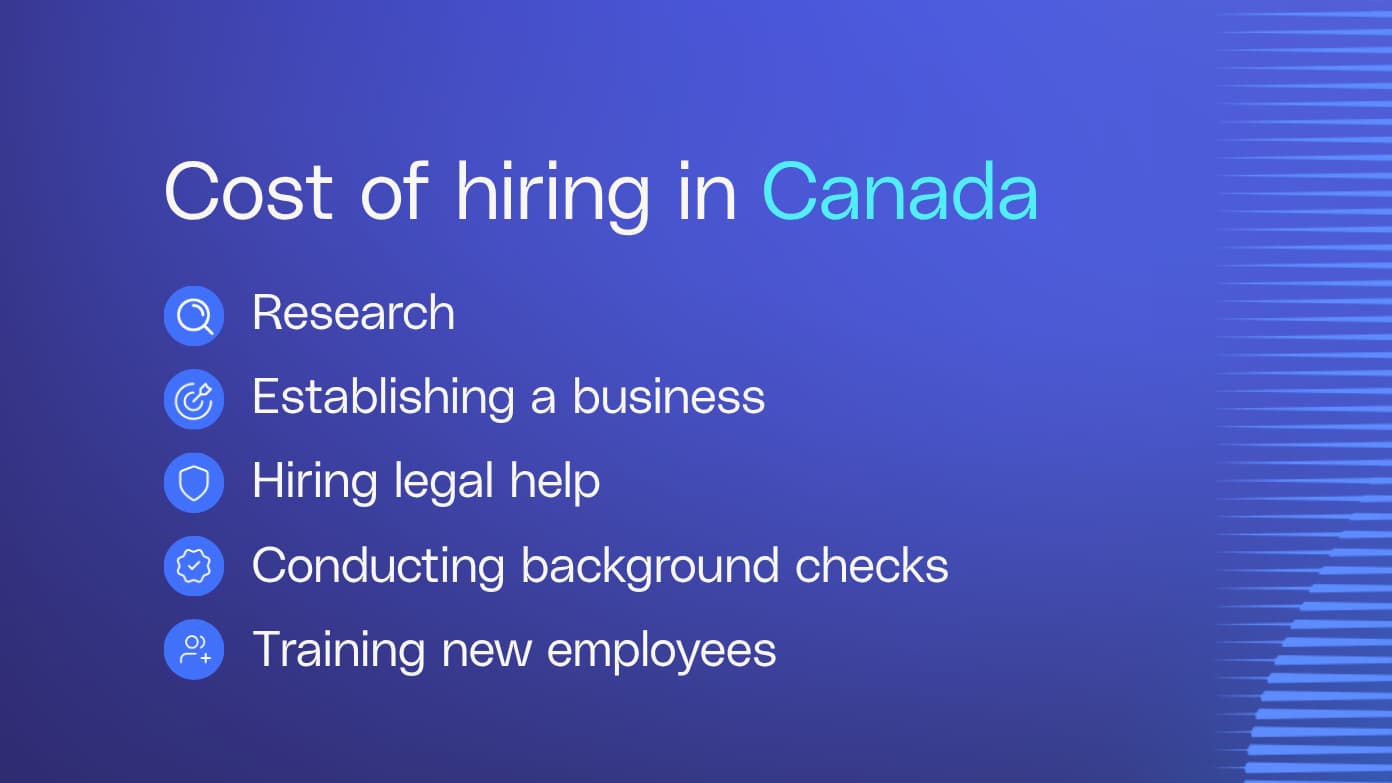
Whether you’re bringing on one team member or setting out to hire employees in Canada at scale, expenses are inevitable. Budget for the following:
- Research: Determine where in Canada you want to set up your business or recruit talent. Employment standards and legal requirements are different based on whether your workers fall under federal or provincial/territorial jurisdiction, your specific industry, and the physical location of remote workers.
- Establishing your business: Unless you work with an Employer of Record (EOR), you’ll have to set up a branch or subsidiary in Canada and cover the related costs.
- Posting the job ad: Posting your job ad may also cost you. However, Canada has a public job board called Job Bank where you can post job ads for free.
- Legal checks: Background checks or verifying an applicant’s legal right to work can add to your hiring costs for hiring in Canada.
- Training: Hiring a new employee isn’t the end of your hiring costs. The next step is to invest in training to help your new hire become productive faster.
G-P Verified Sources from Gia estimate the total annual employer burden rate in Canada, which includes costs triggered on top of salaries, is between 7% and 12%. Rates depend on the employee’s earnings, province of employment, and the industry.
Background checks when hiring in Canada
In Canada, employers verify identity, work authorization, and education. Additional checks such as criminal or credit history have to be job-relevant. The key principle is to collect only necessary information and avoid overly broad screenings.
Employers have to give clear notice and get written consent before doing background checks. The notice has to include:
- the types of checks
- their purpose
- data retention details.
Employers have to secure this personal data, restrict access, and allow candidates to correct any inaccuracies.
Employers have to avoid blanket disqualifications and assessing results individually against job requirements. Human rights laws prohibit using protected grounds like criminal history or disabilities. For compliance, carry out sensitive checks after conditional offers and follow best practices.
When hiring in employees in Canada across provinces or for sensitive roles, consult an EOR or to navigate local regulations.
What does a company need to hire employees in Canada?
Make sure you cover these essentials before expanding your team in Canada:
- A compliant employing structure: Hiring in Canada needs a compliant structure. While setting up a local branch or subsidiary is common, you can hire through an EOR or work with independent contractors. Non-resident employers can hire Canadian workers directly by registering for payroll with the Canada Revenue Agency (CRA) without a local legal entity.
- Incorporation and extra-provincial registration: If you choose to incorporate locally, you can do so federally or provincially/territorially. Keep in mind that federal incorporation requires extra-provincial registration in every province or territory where your business operates.
- Payroll deduction accounts: Employers have to get a business number (BN) and set up a CRA payroll account to deduct and pay federal income tax, CPP, and EI. In Quebec, registration with Revenu Québec is needed to handle QPP, QPIP, and provincial tax withholding.
- Employment agreements & onboarding forms: You have to issue localized employment agreements that follow governing laws and collect payroll onboarding documentation, including each employee's social insurance number (SIN) and proof of their legal right to work in Canada.
- Permits and licenses: Depending on your business activities, you can need specific federal, provincial/territorial, or municipal permits. You can use BizPaL, a joint government online tool, to identify the licenses for your industry and location.
- Workers’ compensation insurance: Coverage is mandatory but registration timelines and governing agencies are different by jurisdiction (WCB in Alberta, WorkSafeBC in British Columbia, or the WSIB in Ontario).
- Employment standards and OHS compliance: Employers have to adhere to applicable federal or provincial/territorial legislation governing minimum wage, hours of work, statutory holidays, and termination rules. You have to keep compliant occupational health and safety (OHS) standards.
- Human rights, accommodation, and local policies: Workplace practices have to follow relevant human rights legislation, including duty-to-accommodate responsibilities and any mandatory province-specific policies or training (accessibility standards or workplace violence and harassment prevention).
Use G-P EOR to hire employees in Canada without setting up your own entity. Build your team in Canada at a lower cost and with peace of mind that you’re doing so compliantly.
Steps to hiring in Canada
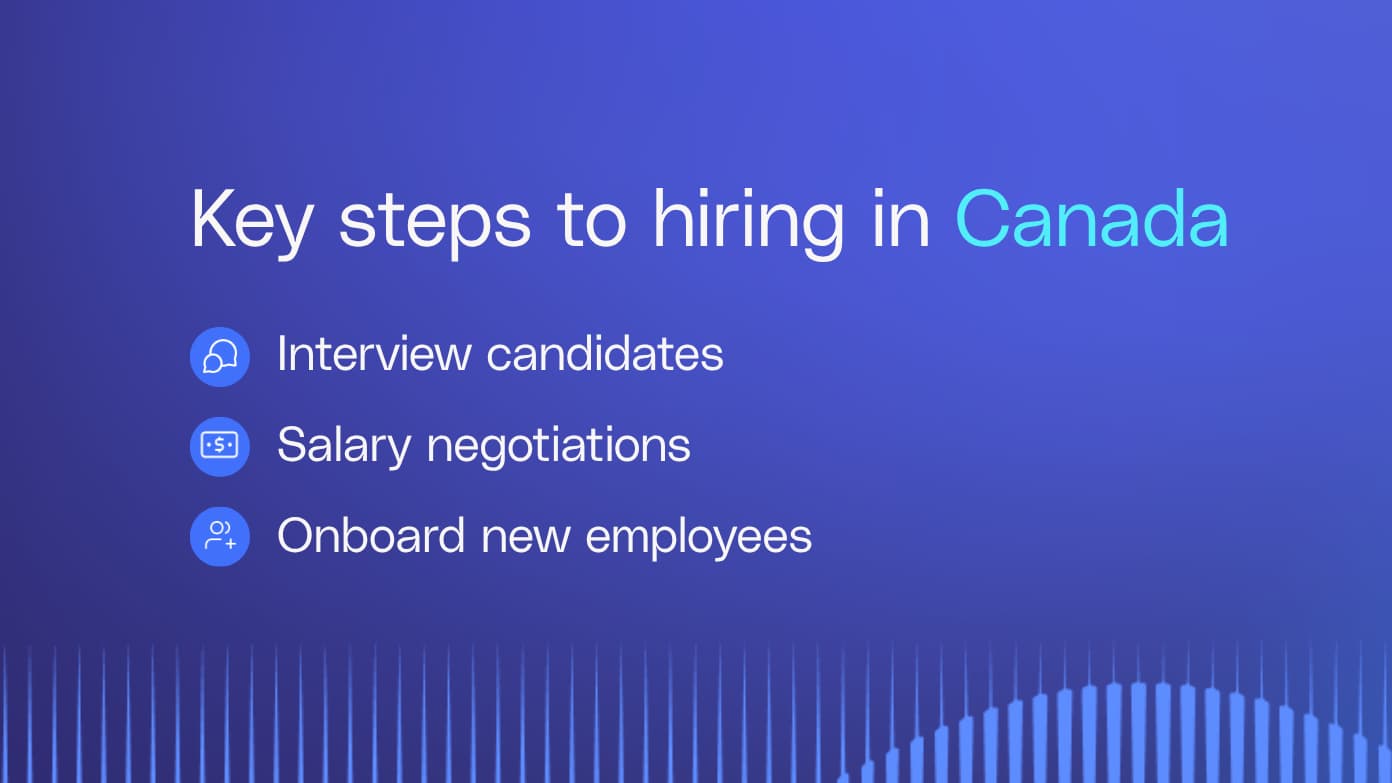
There are five basic steps for hiring in Canada. We’ve summarized these steps below, along with tips based on local customs and requirements that govern hiring practices in Canada.
1. Post a job ad
The first step is to determine the skills you’re looking for. Compile this information into a detailed job ad. You may want to publish the ad in both French and English, depending on the province.
When listing any educational requirements, remember that in Canada, the term “college” refers to schools that teach specific trades or career skills and grant diplomas, while “university” refers to degree-granting institutions.
2. Evaluate applications
Once the applications come in, decide which candidates will move on to the interview stage. You can use software or an agency to help with the initial screening process, or you can have your team complete this task internally.
3. Interview candidates
Next, interview candidates who made it onto your shortlist. You can conduct interviews virtually or in person if you have a branch or subsidiary set up. Phone or video interviews are especially helpful if you’re hiring remote employees in Canada and want to avoid traveling there.
If you’re scheduling a virtual interview, consider the time difference. Canada has several time zones that span a difference of four hours. Schedule your interview during overlapping business hours between your country and the candidate’s province.
4. Follow up and draft a contract
Once you’ve chosen the ideal candidate, follow up and formally offer them the job. It’s common for employees in Canada to negotiate their salary. You should also create a contract at this stage.
In Canada, an employment contract can be formed verbally but a written agreement is strongly recommended to document expectations and reduce legal disputes. A compliant employment contract should include:
- job title and duties
- start date
- work location (including remote or hybrid arrangements)
- working hours
- Compensation
- overtime rules
- statutory leave
- vacation entitlements
- probation terms
- notice or severance obligations.
G-P EOR has an Employment Contact Generator to help you draft compliant employment contracts when you hire in Canada.
5. Onboard your new hire
Now you can onboard your new hire. Request your new hire’s Social Insurance Number (SIN) card within three days of their start date, and record the information on it. Employees must fill out the Form TD1, Personal Tax Credits Return, from the federal government and from their province, so you know how much tax should be taken out of their paychecks. In Quebec, the provincial form is known as Form TP1015.3-V.
Onboard your team members in Canada in minutes with G-P EOR. We’ll handle the legal and administrative tasks, so you can start working faster. Simple, self-guided workflows ensure a smooth process for you and your new hires.
Hiring contractors in Canada
Working with independent contractors in Canada can be a cost-effective way to test the market and build a presence without the commitment of full-time employees. Contractors based in Canada understand local consumer behavior, rules, and business practices. They’ll be ready to start working quickly with their own equipment and established work processes.
Hiring contractors allows you to easily adjust your workforce based on your business needs, without the complexities and costs of employment.
Before you enter an agreement with an independent contractor in Canada, consider the following:
1. Employees vs. independent contractors
In Canada, employers hire employees to do work and, in return, pay them a regular salary or wage. Independent contractors provide services. Unlike employees, contractors set their schedules, use their own equipment, and work on specific projects, rather than having an ongoing role.
2. Penalties for misclassification
Classifying someone as a contractor when they’re not can lead to severe penalties. If misclassification occurs, you may need to:
- Pay back taxes, including unpaid income tax deductions, Canada Pension Plan (CPP) contributions, and Employment Insurance (EI) premiums.
- Cover the cost of unpaid wages, benefits, and protections under labor standards to misclassified employees.
- Face audits and investigations from the Canada Revenue Agency (CRA).
3. How to pay contractors in Canada
G-P Contractor™ takes away the messy, time-consuming process of hiring and paying international contractors. You can create and issue contracts and pay contractors with just a few clicks, all while ensuring a compliant process.
Hire Canadian employees and contractors with G-P
Our SaaS and AI-powered products – EOR, Contractor, and Gia – help companies of all sizes build and manage global teams.
With more than a decade of experience, the largest team of HR, legal, and compliance experts, and a global proprietary knowledge base, G-P is the recognized leader in global employment.
Contact us or book a demo today to simplify your path to hiring employees in Canada.

Frequently asked questions (FAQs)
How do probationary periods work in Canada?
Probationary periods are typically outlined in employment contracts and can vary by province. They generally range from three to six months, during which either party can terminate the contract without cause.
What are the requirements for registering employees with social security?
You must register employees with the Canada Revenue Agency (CRA) for payroll purposes and make all necessary contributions to the Canada Pension Plan (CPP) and Employment Insurance (EI) according to the employee's salary.
What are the rules regarding working hours and overtime in Canada?
Standard work hours and overtime regulations vary by province. Generally, the standard workweek is 40 hours. Overtime pay is required for hours worked beyond this threshold.
What kind of leave benefits are employees entitled to in Canada?
Employees are entitled to statutory benefits, such as paid vacation, maternity leave, parental leave, and access to Canada's public healthcare system through social security contributions.
What are the anti-discrimination laws in Canada?
The Canadian Human Rights Act prohibits discrimination based on gender, age, disability, and other protected characteristics. These laws are enforced at both federal and provincial levels.