





Key Takeaways
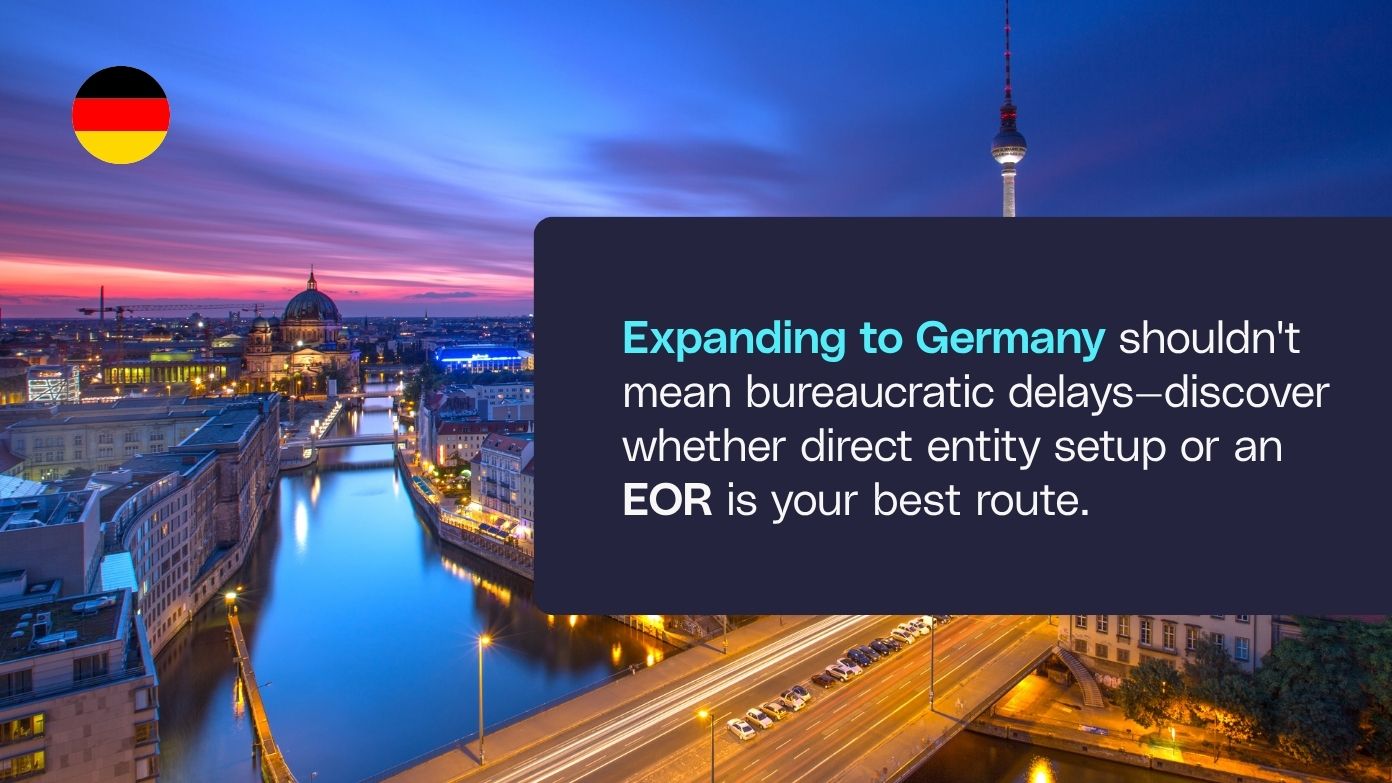
- If you want to expand your business to Germany, you can either set up an entity or use an employer of record (EOR).
- Setting up a business in Germany involves choosing the right legal structure, completing registration requirements, and understanding local tax, labor, and compliance obligations.
- Non-EU founders may need to meet extra requirements, including residence permits, document legalization, and banking procedures before they can start a business in Germany.
- Businesses that need to enter the German market quickly may benefit from an EOR model, while companies planning a long-term presence may choose direct registration.
Germany is one of Europe's most attractive markets for international expansion, offering access to a highly skilled workforce, a stable business environment, and the broader European Union market. However, entering the market requires more than identifying business opportunities. Companies expanding into Germany must choose the right business structure, complete the required registrations, and understand the country's legal and tax requirements before they can begin operations.
You can establish a local legal entity or hire team members through an employer of record (EOR) without completing business registration in Germany. Each approach offers different advantages depending on your expansion goals, hiring timeline, and operational needs. This guide explains the key steps for setting up a business in Germany, compares common legal structures, and outlines when an EOR may be the right option.
Before you begin: Essential setup prerequisites
- Business name selection: Your business name must comply with German legal naming rules and, in many cases, should be reviewed by the appropriate Chamber of Industry and Commerce (IHK) in advance. Choosing a compliant name early can help prevent delays during business registration in Germany by identifying potential conflicts before you submit your application.
- Physical business address (Geschäftsadresse): Businesses establishing a presence in Germany generally need a valid physical registered address before completing the registration process. This address is used for official government, tax, and legal correspondence and becomes part of your company's official records.
- Commercial vs. liberal distinction: Before you start a business in Germany, you'll need to determine whether your planned activities qualify as a commercial trade or a liberal profession. This classification affects the registration process, including whether you must register with the local trade office or follow a different registration path.
Key requirements by legal form
Liberal profession (Freiberufler)
- Professions such as doctors, lawyers, architects, engineers, artists, and certain consultants may qualify as Freiberufler if they meet the requirements of Section 18 of the German Income Tax Act (EStG).
- Unlike commercial businesses, liberal professionals generally do not need to register their business with the local trade office (Gewerbeamt).
- Instead of completing trade registration, Freiberufler, register with the tax office through the ELSTER online portal to get a tax number for tax reporting purposes.
- Certain regulated professions must also register with the appropriate professional chamber before practicing, such as the medical, legal, tax, or architectural chambers.
Sole proprietorship (Einzelunternehmen)
- Individuals operating a commercial sole proprietorship must register their business with the Gewerbeamt before or when business activities begin. Trade registration is generally needed for commercial businesses but not for qualifying liberal professions.
- The registration fee varies by municipality, but most businesses can expect to pay between EUR 15 and EUR 65 to complete the Gewerbeanmeldung.
- After your registration is processed, you'll receive a Gewerbeschein, which serves as official confirmation that your business has been registered with the local trade office.
- Once your trade is registered, the Gewerbeamt typically notifies the tax office (Finanzamt), the appropriate Chamber of Industry and Commerce (IHK) or Chamber of Crafts (HWK), and the relevant statutory accident insurance institution, reducing the need to notify each organization separately.
Civil law partnership (GbR)
- A Gesellschaft bürgerlichen Rechts (GbR) is a simple legal structure that allows two or more individuals or entities to operate a business together. It is commonly used for small businesses, professional collaborations, and other joint ventures.
- Although a written partnership agreement is generally not legally necessary, creating one is strongly recommended to define each partner's rights, responsibilities, profit-sharing arrangements, and decision-making procedures.
- If the GbR carries out commercial activities, each partner generally registers individually with the local trade office (Gewerbeamt) as part of the partnership's trade registration process.
- The partnership must also register with the tax office through ELSTER to receive a tax number (Steuernummer) for the GbR's tax filings.
- Each partner is personally liable for the partnership's obligations, meaning creditors may pursue any partner for the full amount of the partnership's debts.
Limited Liability Company: UG vs. GmbH
- Entrepreneurial Company (Unternehmergesellschaft / UG):
- Minimum share capital of EUR1, with EUR500–EUR1,000 recommended to cover initial fees. A UG can be established with as little as EUR1 in share capital, although many founders contribute EUR500 to EUR1,000 to help cover startup costs and provide working capital.
- Retains 25% of annual net profit in a statutory reserve. A UG sets aside 25% of its annual net profit in a statutory reserve until the company's share capital reaches EUR25,000. If the company does not generate a profit, no contribution to the reserve is made.
- May convert into a standard GmbH once share capital reaches EUR25,000. After increasing its share capital to EUR25,000, a UG can convert into a GmbH by completing the necessary legal steps. A company may also continue operating as a UG if it chooses.
- Limited Liability Company (Gesellschaft mit beschränkter Haftung / GmbH):
- A GmbH begins with a minimum share capital of EUR25,000. When contributions are made entirely in cash, at least EUR12,500 is generally deposited before the company is registered.
- The company's articles of association are signed before a German notary as part of the formation process. The notary then submits the registration application to the Commercial Register.
- A GmbH becomes a separate legal entity when it is entered into the Handelsregister. At that point, the company's shareholders generally benefit from limited liability.
- A GmbH completes beneficial ownership reporting through the Transparency Register and registers its commercial activities with the local trade office (Gewerbeamt) when applicable.
| Feature | Freiberufler | Sole Proprietorship | GbR | UG | GmbH |
|---|---|---|---|---|---|
| Minimum Capital | None | None | None | EUR1 minimum | EUR25,000 (EUR12,500 paid in) |
| Trade Registration | No | Yes (EUR15–EUR65) | Yes (per partner) | Yes | Yes |
| Commercial Register | No | Optional | No | Yes | Yes |
| Notary Required | No | No | No | Yes | Yes |
| Liability | Unlimited personal | Unlimited personal | Unlimited personal | Limited to company assets | Limited to company assets |
Additional steps for non-EU founders
- Visa and residence permits: Non-EU nationals planning to operate a business in Germany generally must apply for an entrepreneur residence permit under Section 21 of the German Residence Act (Aufenthaltsgesetz or AufenthG). Approval depends on meeting the applicable legal requirements and receiving authorization before beginning long-term business activities.
- Business plan review: As part of the residence permit application, founders typically submit a business plan demonstrating that the proposed business serves an economic interest or regional need and is expected to have a positive economic impact. Authorities may also consider the applicant's experience, financing, and the project's long-term viability.
- Document translation and legalization: Documents, such as incorporation records, identification documents, or certificates, often need certified German translations before they can be submitted. Depending on the country where the documents were issued, an apostille or other form of legalization may also be needed.
- Banking hurdles: Opening a German corporate bank account early can help avoid delays during the registration process. Financial institutions typically conduct detailed Know Your Customer (KYC) reviews to verify the company's ownership structure, business activities, and supporting documentation.
Strategic entry pathways: Direct legal entity vs. G-P EOR
- Direct incorporation: Establishing a legal entity gives your business full operational control and a permanent presence in Germany. However, the incorporation process typically takes five to seven weeks, depending on the legal structure and registration timeline, and involves setup costs such as notary and registration fees, legal services, and minimum capital contributions for certain entity types.
- G-P EOR: G-P EOR lets businesses hire team members in Germany in as little as a few days without setting up a local legal entity. This approach can help companies enter the German market more quickly while G-P manages employer responsibilities in accordance with local employment requirements.
| Evaluation Factor | GmbH Structure | UG Structure | G-P EOR |
|---|---|---|---|
| Minimum Share Capital | EUR25,000 (EUR12,500 initial deposit) | EUR1 minimum | None |
| Setup Timeline | 5 to 7 weeks | 3 to 5 weeks | 1 to 2 weeks |
| Upfront Costs | High legal and notary fees | Moderate fees | Predictable monthly fee, G-P EOR starts at USD 599 per month per employee |
| Deployment Limit | Permanent | Permanent | 18-month legal cap per team member assignment |
| Optimal Audience | Scaled long-term team (>15 employees) | Early-stage projects | Quick market entry and testing |
Employer of record deployments and AÜG compliance
- AÜG classification: In Germany, employer of record (EOR) arrangements are generally treated as temporary agency work (Arbeitnehmerüberlassung) under the German Temporary Agency Work Act (AÜG). This means the arrangement is subject to Germany's employee leasing rules.
- Mandatory AÜG licensing: Germany EOR providers operating under the AÜG framework hold the appropriate employee leasing authorization. Working with a provider that does not have the necessary authorization can expose businesses to significant legal and financial risks, including fines under the AÜG.
- Statutory 18-month cap: Under the AÜG, temporary agency workers generally cannot remain assigned to the same client company for more than 18 consecutive months, although limited exceptions may apply under certain collective bargaining agreements.
- Equal pay mandate: Equal pay rules generally apply after nine months of continuous assignment to the same client company unless a qualifying collective bargaining agreement provides a different timeline under German law.
- EOR-to-entity transition: Companies planning to establish their own German entity often begin preparing the transition well before the 18-month assignment limit. Starting the process around month 12 can provide extra time to complete incorporation and transfer workers if needed.
Managing permanent establishment tax risks
- Permanent establishment (Betriebsstätte): A permanent establishment (Betriebsstätte) can create German corporate tax obligations when a business maintains a fixed place of business or carries out activities that establish a taxable presence under Section 12 of the German Fiscal Code (Abgabenordnung).
- High-risk operational roles: Activities such as negotiating or concluding sales contracts, exercising signing authority on behalf of the business, or maintaining a regular executive presence in Germany may increase the likelihood of creating a permanent establishment, depending on the specific facts and circumstances.
- Risk mitigation: G-P EOR separates employment administration from your company's day-to-day business operations. This structure can help you expand into Germany while reducing the risk of creating a permanent establishment before establishing their own legal entity.
German labor law, social security, and employee benefits
- Employer social contributions: In addition to gross salary, employers generally contribute approximately 19.3% to 22% toward Germany's statutory social security system. The exact amount varies based on factors such as the employee's health insurance provider and applicable contribution assessment ceilings.
| Social insurance branch | Total statutory rate | Employer contribution | Contribution ceiling |
|---|---|---|---|
| Pension Insurance | 18.6% | 9.30% | EUR101,400 |
| Health Insurance | 14.6% + ~2.9% add-on | 7.3% + 1.45% = 8.75% | EUR69,750 |
| Unemployment Insurance | 2.6% | 1.30% | EUR101,400 |
| Nursing Care Insurance | 3.6% | 1.80% | EUR69,750 |
| Accident Insurance | 1.09% average | 1.09% average (100% employer) | Industry-adjusted |
- Probationary periods and notice schedules: Employment contracts commonly include a probationary period of up to six months, during which either party may terminate the employment relationship with two weeks' notice. After the probationary period ends, statutory or contractual notice periods generally apply.
- Protection against dismissal (KSchG): Germany's Protection Against Dismissal Act (Kündigungsschutzgesetz or KSchG) generally applies to businesses with more than 10 employees, provided the employee has completed the applicable qualifying period. Covered dismissals generally need a legally recognized social, personal, or business-related reason.
- Written signature requirement: Under Section 623 of the German Civil Code (Bürgerliches Gesetzbuch or BGB), termination notices are only valid when provided in writing with a physical handwritten signature. Electronic signatures and email notices generally do not satisfy this requirement.
- Mandatory leave: German employment law includes statutory paid annual leave, continued salary payments for up to six weeks during qualifying periods of illness (Entgeltfortzahlung), and maternity protections under the Mutterschutzgesetz (Mutterschutz).
Accelerate your Germany expansion with G-P
Expanding into Germany offers access to one of Europe's largest markets, but establishing a legal entity and managing local employment requirements can take time and resources. You can bypass this requirement and start hiring in Germany in minutes withG-P EOR.
G-P's Global Employment Platform is powered by G-P EOR, G-P Contractor™, and G-P Gia™ to support hiring, contractor engagement, and global workforce management through a single solution.
Book a demo to learn how G-P can help you hire team members quickly and confidently today.
Frequently asked questions
How long does setting up a business in Germany take?
Direct incorporation typically takes five to seven weeks, while G-P EOR enables companies to hire team members in Germany in as little as a few days.
What is the difference between a Freiberufler and a Gewerbe?
Liberal professions register only with the tax office. Commercial trades need trade office registration.
What is the minimum share capital for a German GmbH?
A GmbH requires EUR25,000 in share capital, with at least EUR12,500 generally deposited before registration.
What extra steps do non-EU founders need to complete?
Non-EU founders may need to obtain a residence permit, submit a business plan, and provide certified translations or legalized versions of international documents, depending on their circumstances.
Can you hire team members in Germany without a legal entity?
G-P EOR enables companies to hire team members in Germany without first establishing a local legal entity while managing local payroll and employment compliance.
What is the 18-month rule under German AÜG law?
Under Germany's Temporary Agency Work Act (AÜG), temporary agency workers generally cannot remain assigned to the same client company for more than 18 consecutive months, although limited exceptions may apply.
What are employer social security costs in Germany?
Employers generally contribute approximately 19.3% to 22% of gross salary toward Germany's statutory social security system.